
Four of the 10 most valued domestic firms together added a whopping Rs 231,320.37 crore in market valuation last week, with market heavyweight Reliance Industries contributing the most to the overall gains. Last week, the Sensex jumped 884.57 points or 1.61 per cent. While TCS, Infosys and ICICI Bank were the other gainers from the top-10 pack, HDFC Bank, HUL, LIC, SBI, HDFC and Bharti Airtel faced erosion from their market valuation.

To curb raw material imports from China and promote textiles, the Uttar Pradesh government is looking to set up nearly a dozen private textile parks in the state. The textile parks would be established under the UP Textile and Garmenting Policy 2022.

Zomato emerged as the biggest gainer, followed by Reliance, Nestle, Asian Paints and Power Grid.

Ambani and Adani account for a fifth of the net worth of all billionaire promoters in the country and half the combined net worth of the top 10.

Raising overseas debt has become prohibitively expensive due to the depreciating rupee.

Nearly a dozen firms have shown interest in building the foundation model and LLMs, while others have proposed sector-specific SLMs.
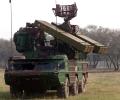
The Indian Army is conducting field trials of several cutting-edge defence systems under 'near-combat conditions', integrating electronic warfare simulations, to assess their performance rigorously, officials said on Saturday.

Campa is set to take on its competition, which pushed it out of the aerated drinks business in the late 1990s, but this time with a new owner - Reliance Industries. Campa's entry comes at a time when aerated drinks as a category is already saturated. But experts say this could give rise to competition in the segment, eventually causing the space to grow.

Ahmedabad-based Torrent Group has completed the acquisition of a majority 67 percent stake in Indian Premier League (IPL) franchise Gujarat Titans.

From the 30 Sensex firms, Mahindra & Mahindra, Infosys, Kotak Mahindra Bank, JSW Steel, Adani Ports, Tata Motors, Adani Ports, ITC and Titan were the major laggards. HDFC Bank, Bharti Airtel, Reliance Industries, Asian Paints and State Bank of India were the gainers.

President Droupadi Murmu's address to the nation on the eve of the 79th Independence Day.

Reliance Industries Ltd on Monday announced an agreement to invest alongside Brookfield Infrastructure and Digital Realty in special purpose vehicles developing data centres in India. Reliance will hold a 33.33 per cent stake in each of the five Indian special purpose vehicles and become an equal partner, the company said in a statement. Digital Realty Trust, Inc is the largest provider of cloud and carrier-neutral data centre, colocation and interconnection solutions globally with 300+ data centres across 27 countries.

Investment by US PE firm KKR will add fire to Ambani's battle for dominance in the retail market that is also being eyed by Jeff Bezos' Amazon and Walmart's Flipkart.
Some of India's largest conglomerates are gearing up to either commission or commercially start the first phase of their new energy projects this year, according to company executives and analysts.

From the 30-share Sensex pack, Hindustan Unilever, NTPC, Nestle, IndusInd Bank, Power Grid, Adani Ports, Tata Motors and Bajaj Finserv were the major laggards. Reliance Industries, Kotak Mahindra Bank, Tech Mahindra, Mahindra & Mahindra and HDFC Bank were among the gainers.

Asian Paints, IndusInd Bank, Nestle India, Maruti, Hero MotoCorp and HUL were also among the gainers, spurting up to 5 per cent. On the other hand, ONGC, L&T and PowerGrid ended in the red. NSE Nifty surged 205.85 points, or 2.29 per cent, to finish at 9,187.30.

Finance, ICICI Bank, Mahindra &h Mahindra, Kotak Mahindra Bank and Titan were among the gainers. Bharti Airtel, Adani Ports, Tech Mahindra, Reliance Industries, Axis Bank, Larsen & Toubro were the laggards.

Reliance Retail Ventures Ltd, run by India's richest man Mukesh Ambani, on Tuesday raised Rs 5,512.50 crore from Abu Dhabi Investment Authority (ADIA), taking the total fundraise to Rs 37,710 crore in less than four weeks.

Tata Motors, Power Grid, Larsen and Toubro, Kotak Mahindra Bank, NTPC, Titan and UltraTech Cement were the other major gainers. ITC, Infosys, JSW Steel, Tech Mahindra and Tata Consultancy Services were the laggards.

Two Reliance group firms - Reliance Consumer Products Ltd (RCPL) and Reliance Retail Ventures Ltd (RRVL) - have announced an open offer to acquire a 26 per cent additional stake in Lotus Chocolate. The firms will together acquire 33.38 lakh shares of Lotus Chocolate from the open market at a fixed price of Rs 115.50 per share, said a notice by DAM Capital, which is managing the offer. The offer will aggregate to a total consideration of Rs 38.56 crore over the full acceptance, said an open offer-detailed public statement shared by the company with stock exchanges on Thursday.

Inventories of rare earth magnets used in critical automotive components - particularly electric vehicle (EV) traction motors and power steering systems - could run dry by mid-July this year, according to rating agency Icra.

Jio Financial Services Limited, the demerged financial services unit of Reliance Industries, will be excluded from various indices of NSE, including the benchmark Nifty 50, from September 7. Shares of Jio Financial got listed on the stock exchanges on August 21, after its spin-off from parent Reliance Industries. In accordance with the index methodology, as JIOFIN has not hit price band on two consecutive trading days on September 4 and 5 at NSE, the Index Maintenance Sub Committee (Equity) of NSE Indices Ltd has decided to exclude JIOFIN from various indices effective from September 7, 2023 (close of September 6, 2023), as per a statement by NSE Indices Ltd on Tuesday.

'This is the Bengal story, where businesses are nurtured, dreams are realised, and legacies are built.'

Billionaire Mukesh Ambani-run Reliance Industries Ltd's retail arm on Thursday raised Rs 9,555 crore from Public Investment Fund (PIF) of Saudi Arabia, taking total fundraise in the last two months to Rs 47,265 crore. PIF will take a 2.04 per cent stake in Reliance Retail Ventures Ltd (RRVL), the Indian firm said in a statement. The investment values RRVL, the retail arm of Reliance Industries Ltd, at a pre-money equity value of Rs 4.587 lakh crore.

India is well-positioned to deal with the negative effects of US tariffs and global trade disruptions as domestic growth drivers and low dependence on exports anchor the economy, Moody's Ratings said on Wednesday.

The Adani family, led by Chairman Gautam Adani, is the most valued first-generation family business at Rs 15.44 trillion.

Only a limited set of investors should invest directly in corporate bonds.
The collective wealth of the 100 richest went past $1 trillion for the first time.

Future group founder Kishore Biyani on Wednesday said the homegrown retail major lost nearly Rs 7,000 crore revenue in first three-four months of the Covid-19 pandemic due to closing of stores, which led him to sell his business to Reliance Industries.

Among the Sensex firms, Power Grid, NTPC, Tata Steel, Tata Consultancy Services, JSW Steel, Wipro, Infosys, Tech Mahindra, Reliance Industries and Bajaj Finance were the major gainers. Axis Bank, HDFC Bank, Hindustan Unilever, Larsen & Toubro and ITC were among the laggards.

Billionaire Mukesh Ambani's Reliance Industries Ltd is the most valuable private company in the country, as per Hurun India's 2022 Burgundy Private Hurun India 500 list. The list, which was released on Tuesday, stated that with a value of Rs 16.4 lakh crore, Reliance is India's most valuable company, followed by Tata Consultancy Services (TCS) with Rs 11.8 lakh crore and HDFC Bank with Rs 9.4 lakh crore. Reliance is also the highest taxpayer with a payout of Rs 16,297 crore and the most profitable company with a bottomline of Rs 67,845 crore in 2022-23.

Billionaire Mukesh Ambani's Reliance Industries Ltd on Friday announced to raise Rs 7,350 crore from two investors -- Singapore's sovereign wealth fund GIC and Global alternative asset firm TPG -- by selling a stake in group's retail arm.

Billionaire Mukesh Ambani's Reliance Industries has invested euro 25 million in German solar wafer maker NexWafe GmbH to use the firm's technology to set up giga-scale wafer manufacturing facilities in India. "NexWafe GmbH (NexWafe) today announced the induction of Reliance New Energy Solar Limited (RNESL), a wholly-owned subsidiary of Reliance Industries Limited (Reliance) as a strategic lead investor in its euro 39 million ($45 million) Series C financing round with an investment of euro 25 million ($29 million) in phase one," the Indian firm said in a late Tuesday evening statement. The investment by Reliance will accelerate product and technology development for NexWafe, including the completion of the commercial development of NexWafe's solar photovoltaic products on prototype lines in Freiburg.

The Delhi high court has rejected a government challenge to an arbitration panel award that had ruled in favour of Reliance Industries Ltd in a dispute over gas migration from fields operated by state-owned ONGC in the KG basin. The government had slapped a provisional penalty of $1.55 billion on Reliance for "unjust enrichment" from gas migrating from the ONGC-operated KG-D5 block to the private firm's adjoining KG-D6 area. It had sought $175 million in additional profit petroleum from Reliance and its UK partner BP Plc.

Russian shipments averaged 1.67 million barrels per day in January compared to 1.48 million bpd in December and 1.53 million bpd a year earlier.

Most of the Sensex firms settled in the positive territory. Mahindra & Mahindra, Tata Motors, Tech Mahindra, JSW Steel, State Bank of India, HCL Technologies, Reliance Industries and Infosys were the biggest gainers. Kotak Mahindra Bank and Maruti were the laggards.
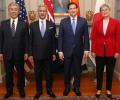
Increasing cooperation in critical minerals will top Prime Minister Modi's agenda during his discussions with leaders of Ghana, Argentinia, Brazil and Namibia.
From the 30-share Sensex pack, Tata Consultancy Services and Infosys jumped over 4 per cent each. HCL Technologies, Tech Mahindra, Adani Ports, Larsen & Toubro, Maruti and Reliance Industries were also among big gainers. Titan, IndusInd Bank, Hindustan Unilever, Axis Bank and HDFC Bank were the laggards.

Meta Platforms Inc, the parent company of WhatsApp, will partner with Reliance JioMart for a service where WhatsApp users can buy groceries on the messaging platform from the Indian retail firm. Mark Zuckerberg, chief executive officer (CEO) of Meta Platforms, said in a Facebook post, "[I am] Excited to launch our partnership with JioMart in India. "This is our first-ever end-to-end shopping experience on WhatsApp--people can now buy groceries from JioMart right in a chat." "Business messaging is an area with real momentum and chat-based experiences like this will be the go-to way people and businesses communicate in the years to come," he said in an announcement coinciding with the annual general Meeting (AGM) of Reliance Industries the parent company of JioMart.

Mukesh Ambani, who took over the reins of Reliance Industries Ltd (RIL) after the sudden demise of his legendary industrialist father Dhirubhai Ambani, completes 20 years at the helm during which the company saw a 17-fold jump in revenues, 20-times surge in profit and has become a global conglomerate.
 © 2026 Rediff.com - Advertise with us - Disclaimer - Privacy Policy - Sitemap - Feedback - About us - Terms of use - Grievances